The Rocket Ship Problem
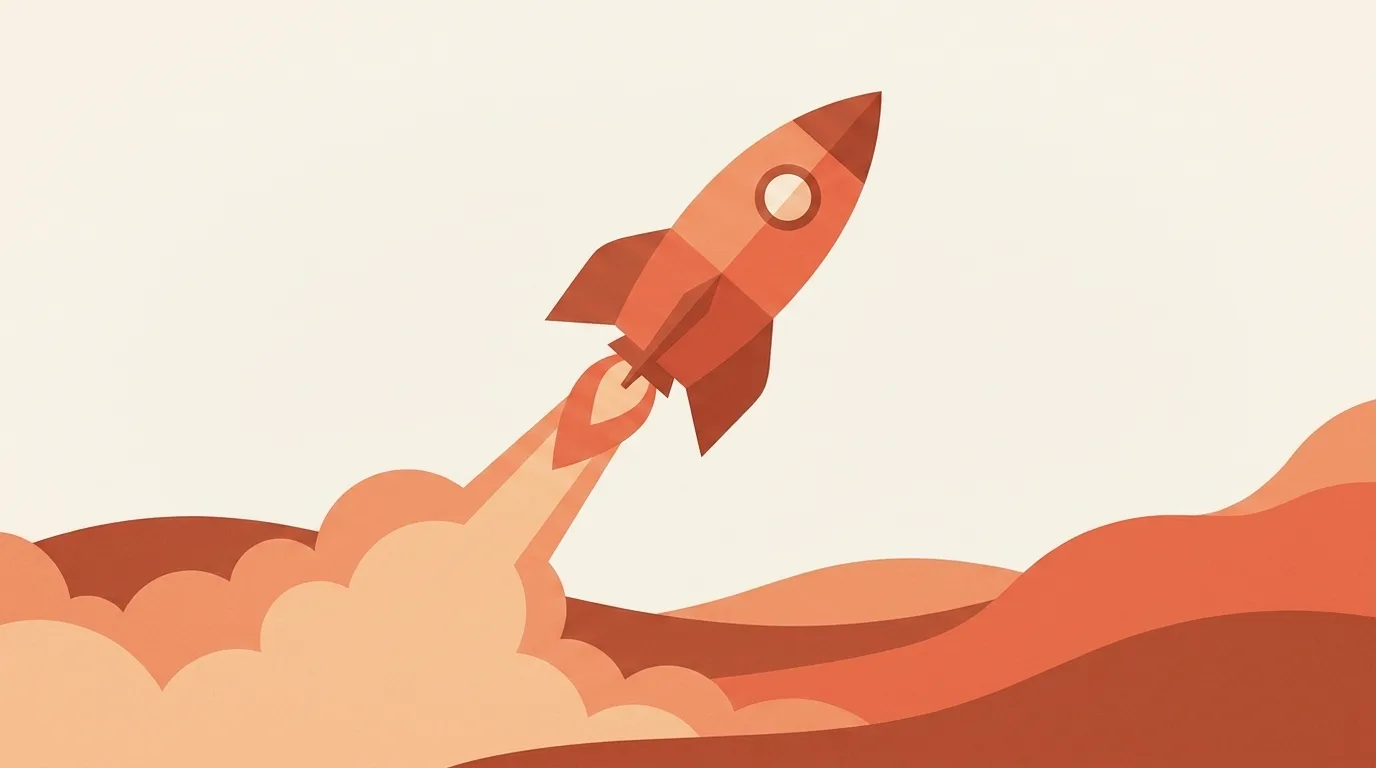
We have rocket ships. We're using them to commute.
Friends were over for games night last week, and somewhere between dinner and the cards coming out, the conversation drifted to AI. It always drifts to AI these days. Someone was telling a story about how a colleague used ChatGPT to draft a performance review, and someone else was talking about how their partner had built a meal planner over the weekend. The usual rotation of small wins and small frustrations. I love these conversations. They're the closest thing I get to a real-time read on how people are actually using these tools, beyond what shows up on my X feed.
Halfway through, I noticed a feeling I wasn't expecting. Disappointment. Not in my friends, who are smart and curious and genuinely making their lives better with these tools. Disappointment in the shape of the conversation itself. We were three years into the ChatGPT era, sitting in our apartment in Lisbon, and everything we were excited about was a slightly better version of something humans already knew how to do.
Write code. Design a website. Analyze a spreadsheet. Draft an email. Plan a meal. Run a workout. Talk through something with a therapist-shaped chatbot. All useful. All faster, cheaper, more personalized than before. And all, when I really sat with it, not new.
I want to be honest about something before I go further. I'm guilty of the same pattern.
In the last few months, I've been using AI to build a to-do list app. A small digital publication. A health tracker that fits the way I actually want to track my health. A tool to help me manage my stock portfolio in a way none of the off-the-shelf platforms quite do. Each one has been genuinely fun to build. Each one solves a small problem in my life that I'd been carrying around for years. I'm not complaining about any of it.
But none of these things are new inventions. They're customizations. To-do lists existed in 1985. Health trackers exist. Portfolio managers exist. What I'm doing is taking categories of software that already exist and tailoring them to my taste, which is a real and valuable thing, but it isn't the future I thought we were building toward.
The wall between technical and non-technical has come down. I've been writing about that for over a year. What I'm noticing now is that most of us, having walked through the gap, are using our new freedom to rebuild the rooms we already had, just with the furniture arranged how we like it.
There's a reason for this, and it's not a mystery. LLMs are trained on the accumulated written output of our species. They are extraordinarily good at producing more of what humans have already produced. Of course they're good at code, and email, and meal plans. We've been doing those things for decades. The training data is rich, the patterns are clear, the outputs are reliable.
What the models cannot easily do, and what we as users have not pushed them toward, is help us make things that humans don't yet know how to make. Not "things I as an individual couldn't build before." Things our species hasn't figured out yet. There's an enormous difference between those two, and I think we're collectively conflating them.
I want to say something sharper, because the soft version of this isn't landing for me anymore.
The AI conversation has been hijacked by the wrong people. Scroll any feed and you'll see the same parade. The prompt engineers selling courses on how to write better prompts. The UGC factories cranking out AI avatars to read scripts to camera. The startup founders raising at billion-dollar valuations to build the seventeenth ChatGPT wrapper for legal contracts. The influencers running threads on "10 prompts that will change your life," which always turn out to be ways to write a slightly better LinkedIn post. This is the discourse. This is what most people think AI is for. And it's making us collectively dumber about what the technology actually is.
I'll go further. Most consumer AI software being built right now is a distraction. Not because it's harmful, but because it's absorbing the talent, capital, and cultural attention that should be going somewhere else. Every smart builder spending a year on an AI-powered note-taking app is a smart builder not spending that year on something that might actually move the species forward. We have a generational tool, and we're pointing it at our inboxes.
The work that matters is happening in places almost nobody on tech Twitter is talking about. Materials science. New molecules, new alloys, new structural designs that no human would have thought to try. Drug discovery. Compounds that come out of latent space rather than out of a chemist's intuition. Protein folding. Decades of stuck progress cracked open in eighteen months. Climate modeling. Patterns in atmospheric data that human researchers would never have isolated. Pure math. Conjectures that have resisted proof for a century being approached from angles no human mathematician proposed.
This is what AI is actually for. Not faster email. Not personalized to-do lists. Not avatars reading scripts. The tool's deepest capability is finding patterns and possibilities that exist outside the range of human intuition, and we are squandering that capability on consumer software that mimics what we already had.
I include myself in this. The four projects I mentioned earlier? They're symptoms of exactly the disease I'm describing. I have access to the most powerful reasoning tool ever built, and I've been using it to optimize my morning routine. The contradiction isn't lost on me. It's why I'm writing this.
I've been sitting with a question for the last few weeks, and I haven't been able to put it down. Is what I'm building a worthy use of this moment? Not the moment in my life. The moment in history. The window where being early to AI-assisted creation gives a single person more leverage than they've ever had. Spending that window on a better to-do list is a choice I've been making, and when I look at it directly, I don't love what I see.
The question I keep returning to in my own work is no longer "what could I make easier with AI?" It's "what could I attempt that I would never have attempted before, because the answer isn't anywhere in the training data?" Those feel like completely different questions to me. They lead to completely different work. And one of them is the question I actually want to be living inside.
I don't fully know what that work looks like for me yet. I have hunches. I'm interested in what AI can find in financial markets that no human investor has noticed, not by mimicking good investors but by reading the data sideways. I'm interested in what it can suggest about how to organize a day, a week, a life, that doesn't just optimize existing structures but proposes ones we haven't tried. I'm interested in what it can do with health, where the patterns are too high-dimensional for any individual doctor to hold in their head. I'm interested in the territory where the tool has to reach.
What I'm not interested in anymore, and what I'm done pretending is interesting, is the to-do list. The note-taking app. The personalized version of the thing that already worked. I'm retiring those projects. Not because they were bad, but because they were too easy a use of something this rare.
After our friends left that night and my partner and I were cleaning up, I told her what I'd been turning over during dinner. We're using rocket ships to commute. She laughed and asked what I'd build instead, if I were trying to use the rocket ship as a rocket ship. I didn't have a complete answer.
But I know I'm done commuting.