Why does vibe coding make me lonely?
I've been vibe coding every single day for over a year. Across every tool I can get my hands on: Lovable, Replit, Cursor, Claude Code, Codex, and a handful of others whose names have already blurred together.
I've used about a billion tokens. Thousands of dollars a month in credits. I know that's not a normal number. Most people hear it and assume I'm either exaggerating or addicted. The truth is probably closer to the second one.
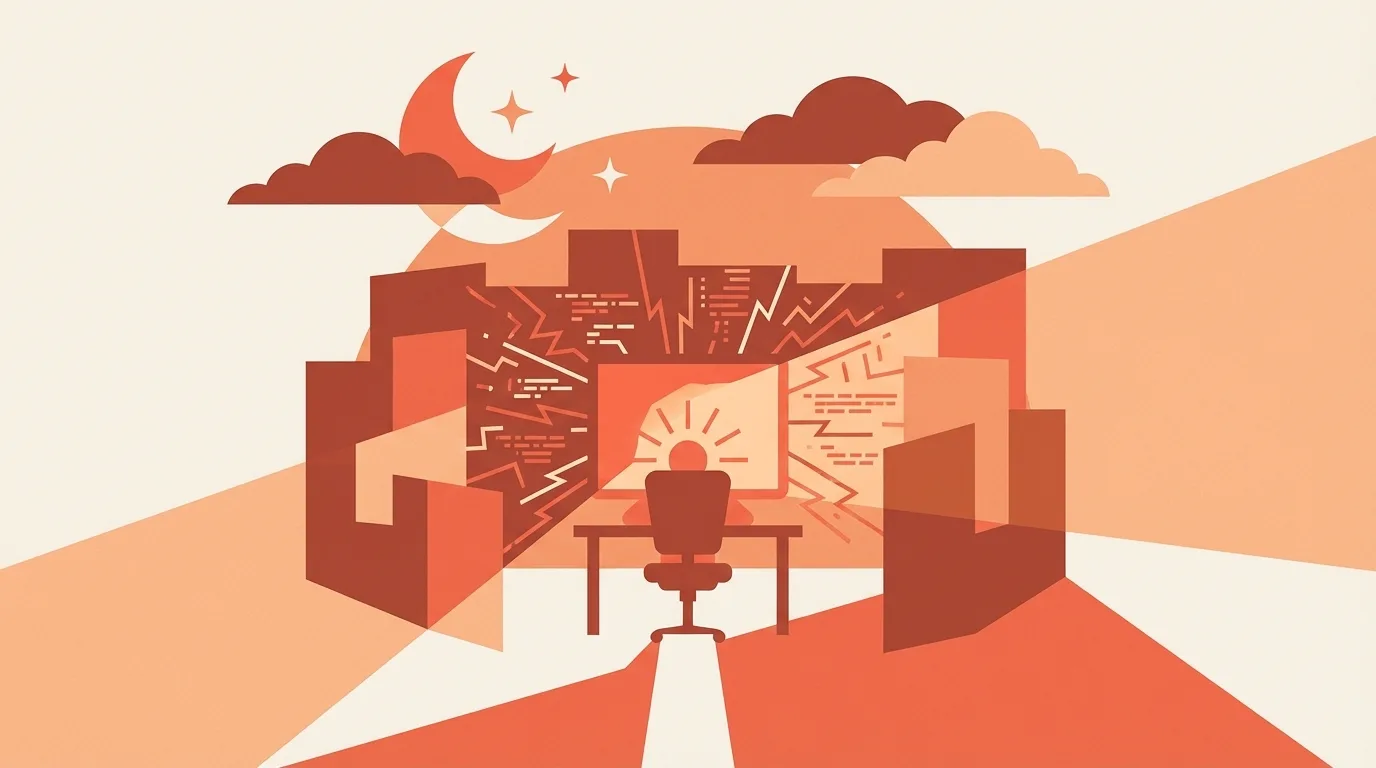
Most mornings I wake up around 4am while our apartment in Lisbon is still dark and my wife is still asleep. I make ginger tea without turning on the lights, the counter familiar enough by now to navigate by feel, and sit down at my desk where the monitor is still glowing from the AI agents I left running overnight. Sometimes I come back to a codebase that's been quietly improved while I slept. More often, I come back to a codebase that's been quietly rearranged in ways I didn't ask for. There's a particular kind of suspense in it, like checking on a house party I left unsupervised.
By 8am there's usually a kind of electricity running through me. A feature that finally clicked, a bug that surrendered after hours of back and forth, an interface starting to resemble the thing that had been living only in my head. That's when I walk to the bedroom, sit on the edge of our bed, and talk too fast about whatever just happened. I think I finally solved the authentication flow. My wife nods, half asleep, says that's great, babe, understanding none of the specifics but all of the energy behind them. It's become our rhythm, these mornings.
Before all of this, I ran a tech company for fifteen years. Scaled it across thirty countries, raised capital, managed engineering teams, sold to Fortune 500 clients. I called myself the Chief Everything Officer because I did everything except the one thing the company actually made. I couldn't write a line of code. For a decade and a half, the building was always someone else's job. I sat on the other side of a wall that separated the people who could imagine things from the people who could make them, and I accepted that wall as permanent.
Then the wall came down.
The feeling of building with AI is extraordinary, and I don't want to understate it. I can go from an idea to a working prototype in hours, standing up features that would have taken my old engineering team months to scope and ship. That first 95% takes maybe 5% of the total effort. It's intoxicating. The first time I looked at something on my screen and thought, I made that, the feeling was real and powerful and I understand completely why people are falling in love with this.
But then the remaining 5% begins. And it is a completely different experience.
Earlier this year, I built a photo sharing app for our wedding. It took a few days. Friends and family uploaded hundreds of photos, thousands of people viewed the site, and my wife and I had this beautiful collection of our celebration. The thing worked. So I expanded it into a full product, something anyone could use. That's when the whole thing cracked open. Other people couldn't figure out where to click. Uploads broke on certain devices. Edge cases multiplied with every new user. I'd deploy agents to fix the bugs, and the agents would create new bugs. The context window would run out mid-conversation and I'd start over from scratch, re-explaining the entire project to an agent with no memory of the last four hours. The app that had worked beautifully for our wedding was barely functional for anyone who wasn't me.
Weeks of this, and not just on the photo app. The same cycle across every project, every tool, every 4am session. Finally a day came where I sat on the edge of our bed for our normal 8am rhythm and I had nothing to report. No feature that clicked. No bug that surrendered. My wife could tell before I said anything.
I give up.
She asked what was wrong. And the honest answer was that it wasn't one thing. Not one bug, not one failed build. Something that had been quietly accumulating for weeks, maybe months. The feeling of pouring myself into something that kept almost working, almost ready, almost good enough to share with others. Almost is a brutal place to live.
**
The hardest part of vibe coding is not the technical complexity. It's the loneliness. There is no standup in the morning where you can say I'm stuck. There is no Slack channel pinging with someone who noticed the same issue. For fifteen years I had engineers, product managers, a whole organization whose job it was to carry the weight together, and I didn't appreciate it at the time. I think you never do. Now there's just me, and the quiet hum of a machine that doesn't know what time it is.
Everyone is talking about the first 95%. The miracle. The speed. The empowerment. And they should, because it is a miracle. What I hear almost nobody talking about is the last 5%, and what it actually costs to get there. Not in tokens. Not in subscription fees. In the quiet, grinding, lonely hours where you're the only person who knows the thing is broken, and the only person who can decide whether to keep going or walk away. I wish someone had told me. So I'm telling you.
The judgment to know when something is worth the grind of the last 5%, and when it's better to take what I learned and build the next thing. That judgment is irreducibly human. No agent is going to develop it for me, and the only way I've found to sharpen it is by getting it wrong repeatedly.
The gap between prototype and production will shrink. The agents will get smarter about not breaking things they just fixed. Context windows will grow. Some of what I've described here will feel quaint a year from now. But the hope, the frustration, the addiction of almost, the question of when to keep going and when to walk away. Those are human problems, and they'll outlast every model update.
**
I've been championing the idea that anyone can build. I'm writing a book about it. I'm currently building a platform around it. And I believe the core of that idea more than ever, because I've lived it this past year in ways I couldn't have imagined even two years ago.
And while everyone is, rightly, celebrating the prototype. What happens after is largely ignored. The questioning of whether this thing you poured yourself into is worth finishing or whether you should just start over. That silence is the gap I'm trying to fill. Because if you're in it right now, you should know: it's not just you.
Whether the hope outlasts the exhaustion, I genuinely don't know.
Ask me again tomorrow.
If you know someone who's been chasing the same bugs, send this their way. They might need to know they're not alone.