Lifejacket
He had been begging to go to the pool, and
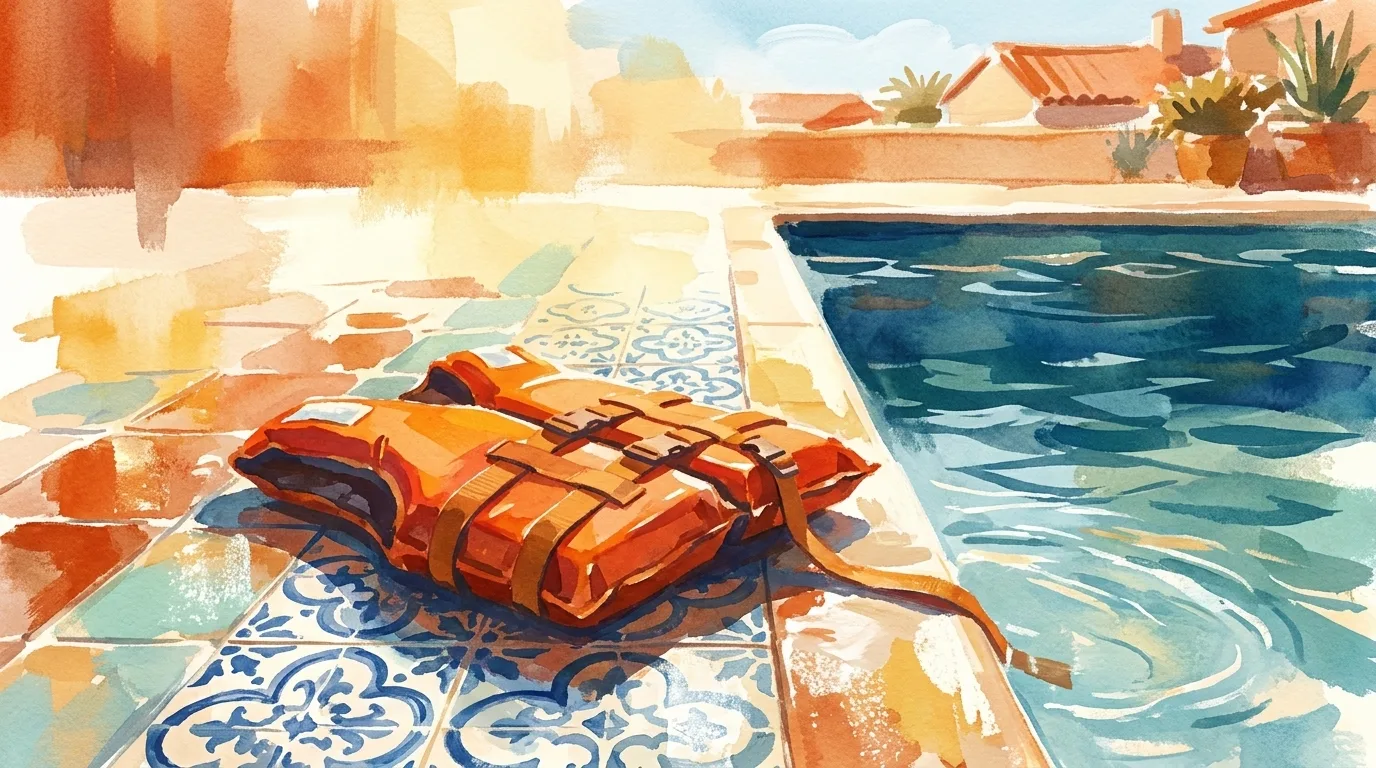
He had been begging to go to the pool, and when it was finally showtime, he stood there at the edge scared to go in.
My nephew, who was visiting us in Portugal a few weeks ago loves water. He had been talking about swimming for days. But standing there in the humid air, looking at the blue rectangle in front of him, something in him caused him to freeze. His feet stayed on the tile. All of his energy seemed to dissipate. His hands gripped the edge of the life jacket like it might float away without him.
I recognized his look immediately. Not because I've seen it in other children, because it was mine, wearing an identical expression when I was a kid, waiting for someone to tell me it was safe.
I was a scared kid around water. I eventually learned to swim, though not particularly well, and even now I carry that hesitation into every large body of water I enter. There's a version of me that never fully got over it. Watching my nephew freeze at the edge, I could feel that version stirring, remembering.
My wife knelt down to his level. She talked to him quietly and didn't rush him. She got in the water first, waist deep, arms open, and let him watch her be fine. That afternoon he made it in. Just barely. Clinging to her, the life jacket doing most of the work, his eyes wide the whole time.
The next day they went again. And the day after. And by the end of the week, the life jacket was off. He was moving through the water on his own, asking to go back to the pool, asking to stay longer. The fear hadn't disappeared exactly. Something had loosened around it. He had found a way to be in the water while still, in some quiet part of him, being afraid of it.
What I noticed most was his joy. Not the joy of having conquered something, which is a more adult emotion. Just the plain joy of being in the water, doing the thing he had wanted to do all along, no longer stopped by the wall of his own fear.
I've had that experience many times in my own life, in smaller and larger forms. When I first moved to Sydney, driving on the left side of the road terrified me. Every roundabout felt like a small crisis. I remember the specific tension of gripping the wheel too hard, of second-guessing every turn, of wondering whether I had chosen the right country to live in based entirely on which side of the road the cars drove on. And then, slowly, it became fun. A puzzle rather than a threat. A daily experiment I was running with nobody but myself.
My fear of heights has been around longer. Once I decided to lean into it, I went skydiving. I went zip lining. I sat on the edge of a cliff and ate a picnic while my mind constructed escape routes. The fear hasn't left. But I've kept finding ways to move alongside it, usually because someone was there, coaxing me forward, or because I had committed publicly enough that walking back felt worse than jumping.
Standing by the pool watching my nephew, I started to notice something I hadn't quite named before. There's a story I've absorbed from Western culture about fear, and about how we're supposed to work through it. The story goes something like this: notice the fear, sit with the fear, understand the fear, integrate the fear. All of the mindfulness, therapy, introspection and reflection I do helps me, however they all are fundamentally solo.
The spotlight goes inward. The work is mine to do. If I'm not making progress, the assumption is that I need more awareness, more insight, more practice, more courage, more time on the cushion.
But I've been aware of my fear of water for decades. Awareness alone didn't teach me to swim. My nephew wasn't sitting with his fear in some meditative posture. He was being coaxed into the pool by someone who loved him and knew what she was doing.
There's a subtle assumption buried in the introspective model: that the more I look at my fear, the more it will loosen. Sometimes that's true. But sometimes the looking becomes its own trap. I become more aware of the fear without becoming any closer to moving through it. The spotlight illuminates the problem without offering a path out.
Not every fear needs to be worked through. Some fears are honest signals that actually deserve caution. But when there's a real desire to move through a fear, when the fear is standing between me and something I actually want, what I've noticed is that I've almost never done it alone.
My wife got in the water first. My friends were on the zip line platform. The instructor was strapped to my back during the skydive. Even in Sydney, learning to drive on the left, there was a whole city of people driving alongside me, silently modeling that this was possible, that they did it every day.
The fear didn't need to be understood. It needed to be surrounded.
Sometimes that surrounding looks like asking for help. Sometimes it looks like being pushed by someone who sees more clearly than I do. Sometimes it just looks like being in the presence of others who have already made the crossing.
In the moment, being pushed doesn't feel good. It rarely does. But the alternative is standing at the edge of the pool for the rest of my life, growing increasingly aware of my hesitation and no closer to being in the water.
My nephew left at the end of the week. His parents sent us a video a few days later. He was swimming, no life jacket, grinning at the camera. Whatever had happened in Lisbon had traveled with him.
I don't think he beat his fear. I think he found out he wasn't the only one holding it.