AI, cognitive load and the things we no longer have to do
Chapters
Quotes
Host
Ross Dawson
Futurist, keynote speaker and founder of Humans + AI, a community and podcast on how AI can amplify human thinking.
Podcasts, talks and interviews where someone else held the microphone.
PodcastHumans + AI Futurist, keynote speaker and founder of Humans + AI, a community and podcast on how AI can amplify human thinking.
 Video podcastIn The Blink of AI
Georgie Healy hosts In The Blink of AI on the Day One network, talking to people shaping how we live with AI.
 Video podcastThe Seen
Kaia Tham’s show about people building unusual lives and companies.
 Video podcastThe Seen
Kaia Tham’s show about people building unusual lives and companies.
 TalkBetter Societies
Adrien Harrison’s Better Societies: a how-to guide for building better societies.
 Video podcastA Success of Our Own
Natalie Ruskin’s show for anyone ready to create their own authentic version of success.
 Video podcastTheStevePodcast
Conversations with the authentic unprofessionals who are changing industries.
 InterviewSander Recommends
For people thinking about moving abroad, buying property, starting a business or investing internationally.
Jon Davids talks to entrepreneurs and creators about how they made it.
 Video podcastThe Red Chair
Índico Capital Partners, a Lisbon venture firm, hosts a monthly close-up conversation in two big red chairs.
 Video podcastThe Business Leadership Podcast
Edwin Frondozo interviews business leaders on how they lead and grow.
 PodcastThe Growth Suite Leadership Podcast
Jonathan Spiess on leadership and building high-growth teams.
 PodcastStigma Podcast
Stephen Hays on mental health, and the people working to remove its stigma.
 PodcastSober Company
Nik and Lacey on living alcohol-free, with guests on the habits that replace drinking.
 PodcastAdExchanger Talks
The podcast of AdExchanger, the trade publication for advertising and marketing technology.
 Video podcastThe JOMOcast
Christina Crook, author of The Joy of Missing Out, on living well with technology.
 TalkUniversity of Waterloo
The University of Waterloo’s alumni webinar series. Kunal studied software engineering there.
 TalkTEDxSiliconNorth
An independently organised TEDx event for Canada’s tech community.
Kunal Today I want to talk about opportunity and where I see opportunity, not only in Canada, but in the world of really three areas where I've become very passionate about. The first and foremost is entrepreneurship, and that's the idea that young people can start businesses, can lead businesses, can join small companies, can be entrepreneurial within big companies, and make things happen. The second theme is mobile. And, you know, you'll never see me with only one mobile device. You know, we're in a connected world, and the world is changing because of how we're using mobile devices. And the third aspect is media. And the media industry, because of digital platforms, is going through massive transformation. The business models are changing, the consumption habits are changing, and that all screams one word to me, and that's opportunity.
Kunal Now, the world is changing. The way we communicate, the way we buy, the way we date, the way we work is changing. And we need to recognize that the younger generation, I don't have kids, but, you know, my nieces, my nephews, some of you may have young kids, they're digital first generation. They're learning how to learn through a touch screen. If you look at a two-year-old and how they use the iPad, they know how to use it better than, you know, twenty and thirty-year-olds. People are gonna change the way they communicate and the way they learn through all these digital platforms. I joke that up until about a year ago, my parents used to call me. That doesn't happen anymore. I literally BBM with my dad, and my mom emails me.
Kunal And if you've ever received an email from your mom, it's usually about six words long, and it sounds like she's getting mad at you every single time. So that's effective communication. That's changing the way we're communicating and the way we're getting things done. And because the world is changing, what we need to recognize as businesses, as organizations, as governments, is how are we adapting to that change? And I'll walk through a couple examples where we have not adapted to that change. So on your left, you've got, uh, Mubarak, a dictatorship that lasted thirty years. And on your right, you've got six characters.
Kunal How did six characters take down a dictatorship that was in power for thirty years? So you think of Twitter as a communication platform, as a platform for change, a platform for movement. That's something that's not an idea. That's something that's happened this year, and something that's gonna continue to happen.
Kunal On the left, you've got Blockbuster's stock over the past six years. And on the right, you've got the stock of Netflix over the past one year.
Kunal You know, Netflix should have been Blockbuster, or Blockbuster should have been Netflix. And you've got to believe somebody within the Blockbuster organization came up with the idea for Netflix. I guarantee you it wasn't somebody on the management team. And I guarantee you that idea wasn't heard or listened to. So within the organizations that we run, that we work in, that we support, how are we embracing ideas, innovation within our organizations? 'Cause I guarantee they exist. They're there. Uh, but we're not fostering them enough yet. And that's a result or an example of what happens when we don't embrace change.
Kunal In the middle, you've got IBM's Watson computer, which, you know, beat what Jeopardy! was calling the smartest guy on the planet, Ken Jennings. You know, we read in science fiction novels that computers will one day become smarter than us. It's actually happened. And I read a couple of weeks ago that Watson, the computer by IBM, is now going to med school and teaching doctors at the University of Maryland.
Kunal So that's -- these are all examples of things that are happening today and how our world has already changed. And in one word, that screams opportunity. And we as organizations, as a society, as a culture, need to embrace that opportunity. We need to embrace that change.
Kunal So now stepping into mobile. About four years ago, Steve Jobs stepped up on stage, held an iPhone in his hand, and called this a magical device. The first generation iPhone wasn't actually a very good phone.
Kunal Didn't have any apps, wasn't even 3G. And we all went gaga over the first iPhone.
Kunal Apps didn't show up till a year later. And there are stories, and I've, you know, met with execs at Apple that have shared with me that the original vision had nothing to do with allowing third-party software on these devices. But here's an example of a company that embraced change or allowed the ecosystem to grow, even if that meant changing their vision or changing their direction or changing their strategy. On the outside, it looks like a perfectly executed strategy and plan. Uh, on the inside, it's an example of an organization constantly adapting and constantly changing and listening and trying and innovating.
Kunal Clicker stopped working.
Kunal Maybe it's the battery.
Kunal We've had PowerPoint for about two decades now, right?
Kunal Thank you. So we look at Android, and Android is amazing in terms of the growth. I wanna touch on kind of the great, the bad, and the ugly of Android. And the great is the growth that it's experienced. Two and a half years ago, this operating system as a platform, as a mobile platform, did not exist, and today it's positioned to be the largest mobile operating system globally. And how did that happen? Well, strategically, the model for Android is separating the software from the hardware. Apple's model, you buy the hardware, you get the software, the Apple software. RIM's model, you buy the hardware, you get the software. Android model, you buy a Samsung, LG, or Motorola, you're getting Android software. Samsung, LG, Motorola happen to be the number two, three, and four cell phone makers globally.
Kunal And it's off the backs of these really big, established companies with strong distribution that Android's been able to really build their distribution. Very clever. That's the great part about Android. The bad part about Android is there's a lot of fragmentation, and we talk about it in, in one word, and people understand it, and some people don't understand what fragmentation means. But the fragmentation is so complex, where carriers and handset guys and everybody's changing Android, that makes it a very tough ecosystem to be on in a sustainable and scalable way. And the ugly part, which very few people are talking about, is it's very hard to make money on Android for a whole number of reasons, whether it's fragmentation, whether it's challenges with billing infrastructure.
Kunal When you look at how much money is being paid out by the handset app stores to developers, Apple is actually number one, RIM is number two, and Nokia is number three, and Google, Android is number four.
Kunal So when we look at where to invest and where to take bets and where you see opportunities for your businesses or for your products or for your organizations or for your ideas, I've learned and I've observed you, you have to encompass all the different factors. And when it comes to mobile, making money is, uh, one of those factors.
Kunal So at the time these slides were made, probably two weeks ago, this is the number of apps that existed out there on smartphones.
Kunal Three years ago, there, there weren't very many apps. We've got half a million apps today. I predict by the end of this year you'll have over a million apps. By the end of next year, you'll have at least two million apps, and it'll continue to grow. So if you're sick of hearing about apps, too bad. It's not going away anytime soon. And up until now, it's been apps for smartphones, and you're seeing apps on all these devices and different distribution channels for apps. We're gonna see apps on tablets, and tablets are going to extend beyond the iPad. Today, it's very much an Apple-dominated space, but you've got RIM and HP and LG and Samsung and Motorola, Acer, Asus, all these companies launching their own tablet devices, and we're gonna see tablets everywhere.
Kunal This is a device that we didn't think we needed. Some argue we still don't need it, but we're all using it, and if we're not using it today, we will be using it within the next twelve months. And that screams opportunity, `cause you've got all these devices getting out there, and now what do consumers do with these devices?
Kunal We're gonna have apps on TVs. Not TVs as old as this one, but we're gonna have apps on TVs. And today, it actually technically is possible. Samsung is, is leading that. Nobody's actually using it, though. But when we think of apps on TV, you know, the opportunity is not only about taking video content and leveraging IP channels instead of the cable channels to distribute content. When we think of apps on TVs, we think about how do you create a user experience that's seamless across a TV and a phone, a TV and a tablet? And you all know, as users, you're always within a couple feet of your favorite device, and people spend a lot of time on the couch watching TV. So how does that all fit together?
Kunal And taking it one step further, we're gonna have apps on cars. Once again, not cars as old as this, but we're gonna have apps on cars. And what does that mean beyond the basic navigation, directions, information-type products? So we have apps everywhere, everywhere around you, on all the connected devices, and all the devices that we currently have for vehicles or TVs are gonna get even more connected, and that screams opportunity.
Kunal Now, here's an example of a part of the ecosystem that hasn't embraced the change. It feels like a game of Survivor with the carriers from multiple fronts. How are they competing against each other in a race to the bottom? How are they adding value to consumers, which I'd argue they're not? And where do they fit? Ten years ago, fifteen years ago, carriers were dominant in the space, and now nobody talks about them.
Kunal So when it comes to seeing the challenges, seeing the opportunities, a lot of ideas are flying, and within our company, we have a lot of ideas. I've talked to a lot of other entrepreneurs, and people within digital media have a lot of ideas. What do we actually do with those ideas? From our experience and, you know, how we started our company, it was about validating and getting early traction. We had our first customer before we had our first product. We had our first, you know, international customer, uh, pretty early in our development, and that was really driven by us getting on planes and going out there and finding the opportunity. The one thing I'll complain about is, as a Canadian entrepreneur, I don't run into enough Canadians in New York, in LA, in London, San Francisco.
Kunal We're not out there. We're not out there chasing business. We're not showing up ready to do business, and that's gonna affect how global our companies can grow.
Kunal I've been on close to thirty planes this year already, constantly flying, and I wanna see more Canadians out there. I wanna see more companies going out there and chasing business versus waiting back for the phone to ring.
Kunal And then it's all about scale. You know, we've had a lot of success in scaling through building a platform and, you know, finding great talent from a technical perspective. We've noticed a challenge not only with our company, but other companies in finding great business talent here in Canada that has experience in scaling and running global companies. So regardless of how great our ideas are and h- how compelling our technology is, this is one aspect of the ecosystem that we need to address. We need to bring in experienced business talent that can take the ideas, take the innovation, take the technical advances, and scale the businesses and build revenue models around it. And that's what's gonna take Canadian companies to the next level and put us on the global stage beyond the one or two Canadian companies that the average, you know, international business person would know about today.
Kunal And we look at other aspects of the ecosystem. So we look at our education system and academics, and, you know, we don't have a lot of time this morning, and I could rant about this for, for a while.
Kunal But this picture probably, you know, clearly explains how a lot of us went through college or, or university. In my last two years at Waterloo, I didn't go to a single class. I last read it by a single textbook. We're not learning in the classroom anymore, and those in the classroom all have their laptops open, are spending their time on, on YouTube, are, uh, are busy on BBM or on Twitter, and that's actually not learning. That's not the purpose of paying high tuition fees and using government funds and getting, you know, great research or prof, profs from overseas to come and educate kind of our youngest and brightest minds.
Kunal The academic environment needs to be a sandbox where people can come up with ideas, experiment, fail, test, try, learn, and build teams. That's what we turned Waterloo into for our company. That's how we started our company while we were in school, by breaking rules, by not going to class, by taking risks, and we need to build a system that encourages more young people to do that before they get sucked up into a large corporate or get sucked south of the border.
Kunal Help wanted. This is for the government.
Kunal There are a lot of big announcements about how there's, you know, ten billion dollars in government funding available for tech companies and innovation. I think from a young entrepreneur perspective or a small company perspective, we don't really care if it's ten billion or one billion. The question is how much of it is accessible to companies like ours. The RIMS and the banks and whatnot are, are great. They've got entire teams focused on sucking this government money. A small company, a company like ours of forty people moving so fast, we don't have time to go after these funds, or we don't have the systems or the experience in how to do it. A business that moves fast, that is hiring fast, the government programs don't fit within the pace and the guidelines that we need them to for us to benefit from them.
Kunal So the message to the government is, how do we direct the funds, the support to the right places that's really gonna drive innovation, really drive job creation in this country? And to the big corporate, you know, how does big corporate support an ecosystem of entrepreneurship and an ecosystem of innovation? It's actually very simple. It's nothing to do with funding or investing in companies. It's all about being a customer. It's all about making it easy for a big company to do business with a small company. It's actually not very easy today. It's not very easy if you're a startup with three or four people to get a big contract or a big deal with a big company. That needs to change, and that creates a, a healthy ecosystem where companies can validate their model. And to the media, it's easy to cover, you know, RIM's stock price taking a beating on Wall Street.
Kunal How do we profile, you know, the young success stories, the companies that are really taking it to the next level and talk about the positive success? And that's the role of the media. So, I mean, in the end, you know, pay tribute to our friend Charlie, and this is what we're all trying to do in the end anyways. And with that, I'll thank you for your time, and, uh, good luck out there.
 TalkMaRS Entrepreneurship 101
MaRS, Toronto’s innovation hub, and its Entrepreneurship 101 lecture series.
 TalkTechTO
Toronto’s monthly tech community meetup.
The University of Waterloo’s startup programme.
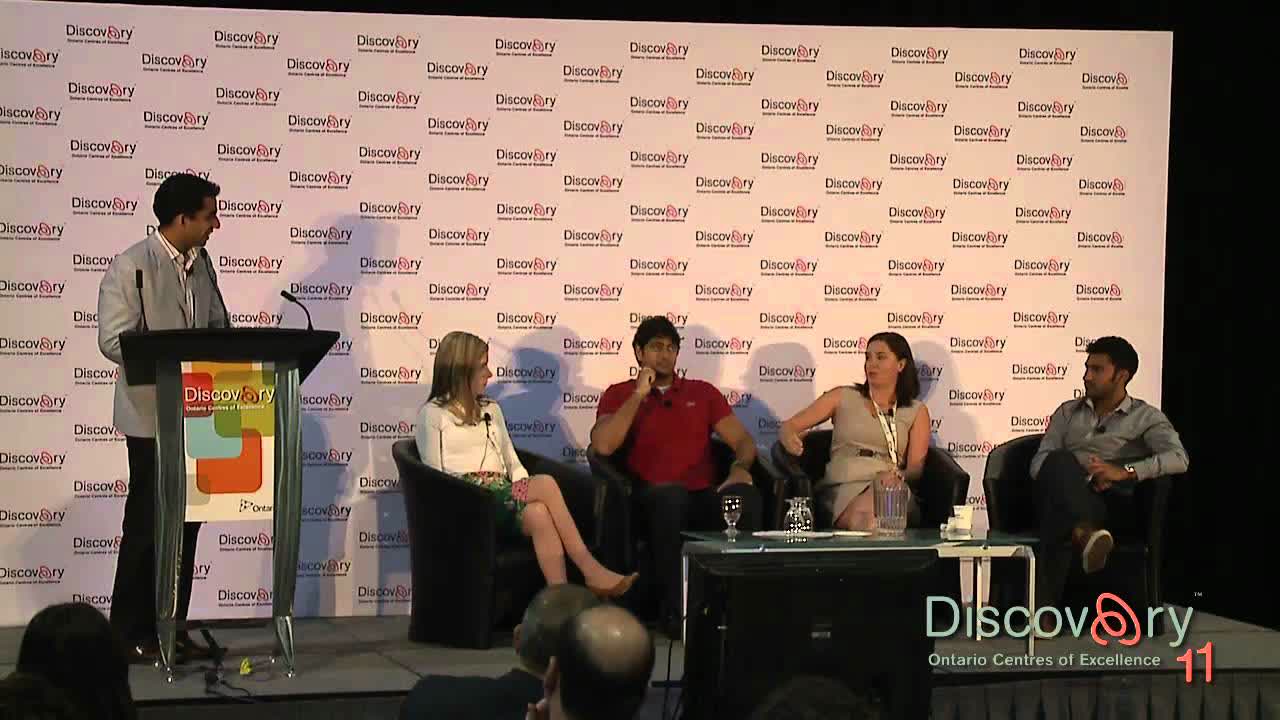
Ontario Centre of Innovation’s annual Discovery conference. Kunal moderated.
The Financial Post’s technology desk.
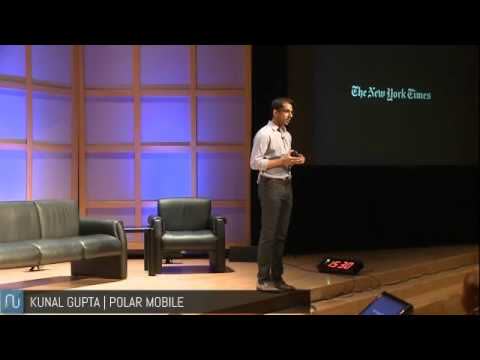
A show about the mobile industry and the people building it.
Canadian technology news for business leaders.
The national voice of Canada’s universities.
No conversations in this format yet.